
Screen Time Boundaries: Resources


Building Healthy Tech Habits for an Online World
Building healthy habits takes a mix of good tools, real-world experiences, and a little everyday balance. We’ve gathered some of our favorite freebies, downloadables, books, activities, and hands-on resources to help kids keep learning important social concepts and life skills all year long. Think less “more screen time” and more “mix it up.”
Technology is a huge part of learning and everyday life, and we’re not against screen-based learning at all. But mixing in offline activities can give kids’ brains, bodies, and eyes a well-deserved break while making more room for creativity, movement, curiosity, and connection. These ideas are a great way to complement what kids are already learning from you, online, at school, and from the world around them. Explore the resources below for simple ways to keep kids learning, creating, playing, and growing both on and off the screen.
Free Articles & Downloadables
Explore our articles and practical guides designed to bridge the gap between digital habits and real-world social awareness. This collection examines how modern screens impact student safety and behavior, while providing actionable frameworks like the four steps of communication and social perspective taking. From addressing cyberbullying to teaching the nuances of real-world interaction, these materials offer the foundational tools needed to help students confidently step out from behind their screens.

Feeling Safer Behind Screens: Why Real-Life Interaction Feels Harder
Real-life social interaction often feels more difficult and uncomfortable compared to digital communication. Practical strategies and Social Thinking Vocabulary help individuals re-engage with the broader social world by building comfort and confidence in everyday, in-person interactions. Also included: Free downloadable of A Sampling of Social Thinking Vocabulary.

Screens Are Now the Guardrails of Childhood Social Experiences
Screens are part of our everyday world. Most of us rely on them to work, plan, connect, and play. But over time phones and tablets have quietly shrunk much of our social experience into small, focused rectangles we hold in our hands, acting as guardrails and pulling our attention away from external social cues happening around us. This article explores practical ways to help students expand their awareness beyond the screen by learning to “think with their eyes” to gather clues to make sense of real‑world situations. Free Downloadable: Lesson plan and supplementary observation sheet and coloring page.

Teaching Social Thinking and Real-World Communication
Learn how online learning and products from the Social Thinking® Methodology help to make real world communication less confusing for kids (and adults!). We break down the social world into teachable parts, like understanding emotions, joining group activities, and noticing the “hidden rules” that guide everyday interactions. It’s all about helping students build the confidence and social tools they need to connect with others in meaningful, authentic ways.
Social Communication and the 4 Steps of Communication
Early on in childhood development, most individuals learn to coordinate their own body and mind, as well as interpret the words and actions of others to participate with increasing sophistication in the act of communication. It just comes to us. Yet these same skills may not develop intuitively for those with social thinking needs.

Social Perspective Taking & The 5 Steps of Being with Others
Social perspective taking helps us make meaning of people as they interact or coexist together in specific contexts. It also helps us to navigate to self-regulate in the social world—a world where we are consciously aware of each other and adjust what we do and say to meet our social goals. Most of us begin learning to take perspective intuitively as infants, but those with social learning differences and/or challenges may need explicit teaching. Explore what social perspective taking looks like, why it’s important, and how to define it in clear, practical terms. Unpack social perspective taking in 5 steps and learn how to teach abstract social cognitive concepts using this concrete framework, as social learners progress in their journeys toward self-regulation. Free Downloadable: Infographic on The 5 Steps of Being with Others.

Add-a-Thought: Teach an Essential Conversation Skill
Add-a-Thought is a strategy to practice conversational language by making comments about our own lives that connect to other participants’ life experiences and vice versa. Learn how you can use the visual tool to teach skills such as perspective taking, sharing an imagination, conversational timing, and more.

5 Signs Your Child is Being Cyberbullied and How You Can Help
Bullying can take on many forms, and the internet presents yet another way children can torment each other. Cyberbullying can be pervasive; it can follow a child anywhere they have access to a computer or smart phone—at home, school, work, and even while out with friends and family. The good news is you can help. Learn the five signs that your child may be dealing with cyberbullying and what you can do to help.

I'm Interested in You—Well, Sort Of: Social Anxiety, Face-to-Face Communication, Digital Devices, and the Art of Saying "Hi"
As digital devices become ever more pervasive in our world, face-to-face interactions are decreasing while social anxiety and depression are increasing. Discover fresh concepts and activities from the Social Thinking Methodology to help everyone look up from their phones and participate in face-to-face interaction.
Free Downloadables: Communication & Connection
Translating screen time boundaries into real-world connection starts with strong face-to-face interaction. These free, practical resources are designed to help students shift away from screens and build meaningful personal relationships. Download these infographics and thinksheets to provide students with the foundational skills needed to confidently start conversations, actively listen, and show genuine interest in peers.
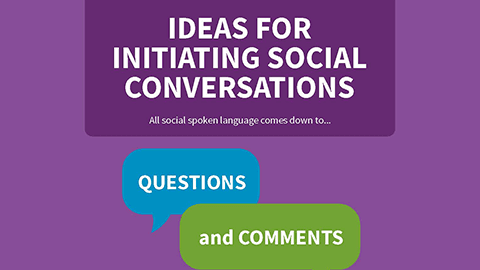
Ideas for Initiating Communication
Download this infographic to learn how questions and comments serve as the foundation for all social spoken language. It offers practical examples for starting dialogues and reminds individuals how to stay alert so they can relate to what others are saying during a conversation.
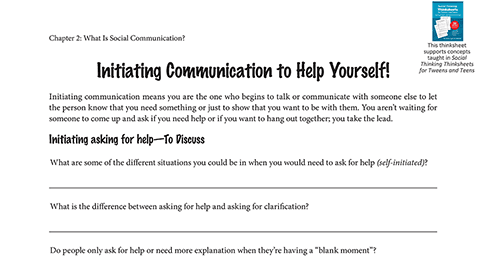
Initiating Communication
This resource supports individuals in taking the lead to begin talking or communicating with someone else instead of waiting for others to approach them. Download this thinksheet to explore discussion questions and brainstorming prompts regarding how to initiate asking for help, ask for clarification, or show interest in another person.
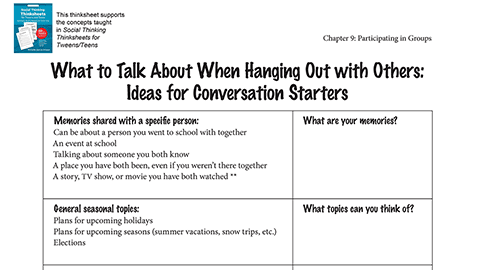
What to Talk About
Help tweens and teens discover fresh ideas for conversation starters when hanging out with others. It provides helpful categories such as shared memories, seasonal topics, and news events to give individuals more opportunities to relate to those around them.
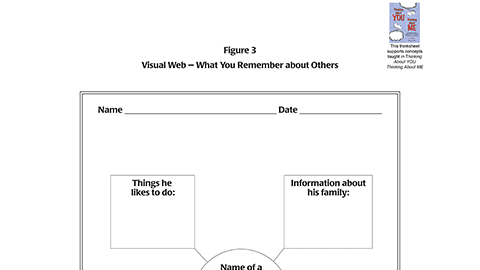
What You Remember About Others
Download this thinksheet to help students organize what they remember about others as they are getting to know someone. It provides a visual template to record information about a person, including things they like to do, family details, school or job information, and preferred foods or restaurants.
Digital Downloads
Looking for quick, ready-to-use activities? Our printable downloads and Thinksheets (thinking-based lesson plans) make it easy to extend your teaching and build real-world connections without a lot of prep work. These resources are designed for small groups, summer camps, therapy sessions, classrooms, or home, with activities kids can work on independently or together. From reflection prompts to hands-on lessons and discussion-based activities, these downloads are a great way for kids to learn away from screens.