
Free Article


Screens Are Now the Guardrails of Childhood Social Experiences
Michelle Garcia Winner, MA, CCC-SLP & Pamela Crooke, PhD, CCC-SLP
Summary:
- Screens like phones and tablets act as "guardrails," limiting kids' attention to small rectangles and pulling their focus away from the bigger social world around them.
- Relying heavily on screens flattens human expression to just faces or emojis, depriving kids of learning how to read body posture, gestures, and other rich, in-person social cues.
- The article introduces a lesson plan and activities to teach kids how to think with their eyes—a foundational skill for observing their surroundings and understanding real-world social situations.
Walk through any busy city street and you’ll likely see a familiar scene: a young child being pushed in a stroller, eyes locked on an iPad held inches from their face. They are physically present in their neighborhood but not experiencing it. Their attention is narrowed to the edges of a small screen. This is what we call the guardrails that limit or block access to the broader social world.
A 40-Year Shift Compared to 6 Million Years of Evolution
In the early 1980s, personal computers entered homes. The 1990s brought laptops, followed by the launch of the iPhone in 2007 and the iPad in 2010. In just four decades, basically an evolutionary blink, human communication shifted from fully embodied, in person social interaction to screen based communication through texting, social media, email, and video conferencing.
For millennia, humans relied on eye gaze, gestures, posture, shared physical space, and intuitive social observation to build connection, read intentions, send social cues. Today, a significant portion of social experience, including social learning, happens through devices that reduce human expression to a small rectangle.
Guardrails: The Physical Edges of Screens Become Psychological Edges
All screens are defined by their boundaries (guardrails):
- Phone: 3" × 6.25"
- iPad: 10" × 7"
- Laptop: 12" × 8"
These sizes matter. They determine what we see, how much we see, and ultimately, what we learn to focus our social attention to. When students explore academics, friendships, and entertainment within these guardrails, the larger 360 degree world becomes less familiar and more overwhelming.
On screens, we often see only faces or partial faces, without body posture, gestures, or the richer cues of face to face interaction. Even more compelling, technology can replace faces with emojis that flatten and vastly limit human expression.
To thrive socially, children need opportunities to experience the broader, unbounded world beyond their screens. When we enter a new space or travel to a new community, the very first thing we naturally do is observe the people around us; how they move, interact, and communicate. This type of social observation is a foundational life skill, yet it is often overlooked or taken for granted.
One of the key concepts taught within the Social Thinking® Methodology is to encourage students to understand that we can “think with our eyes.” Note: This is not about directing students to make eye contact! Rather, thinking with one’s eyes (it also includes ears and brain) is what we all do to gather information to make sense of where we are, who is present, and what is happening. This is called figuring out the situation.
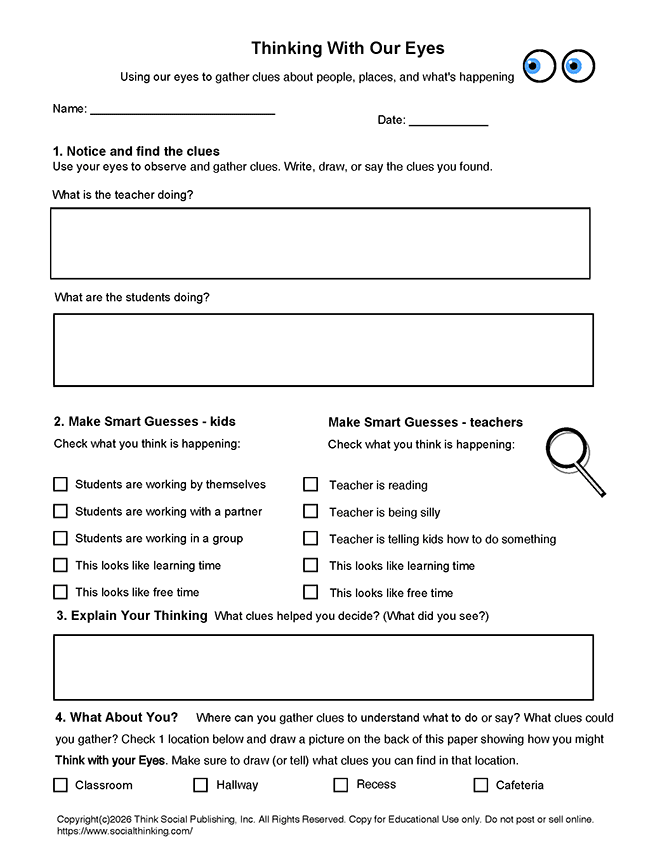
Check out the lesson plan (below), downloadable packet (observation handout and coloring sheet) as a way to consider teaching students to gather clues by thinking with their eyes.
Download Thinking with Our Eyes Packet
Lesson: Thinking with Our Eyes [20-40 Min]
Age Range: Grades K–5, but concept can be taught into middle/high school
Setting: Classroom, therapy room, hallway, outside observation
Group Size: Individual, small group (2–5 students), or whole class
Teaching Area/Target
- Social observation
- Perspective taking
- Nonverbal communication
- Social inference (“smart guesses”)
Materials
- Window or safe viewing area into another classroom (door closed)
- Alternative: photos or short video clips of classrooms (for privacy or logistics)
- Optional: observation sheet
Set the Stage (5–10 minutes)
Sometimes people communicate without talking. They use their eyes, their body, and where they are looking to send messages and give us clues. Even teachers do this!
Explain: We are learning how people think with their eyes to gather clues.
We are not talking about looking at other people in the eye (eye contact).
How do kids do this in the classroom? Did you know that teachers are giving kids clues all day long?
- Write the schedule on the board
- Show pictures in a storybook
- Point towards a lesson on a smart board
- Gesture towards a location or item in the classroom
These are all clues that kids can use their eyes (and eventually their ears, brain) to figure out! We call this Thinking with Our Eyes. It’s a way to notice and gather clues so that we know where we are, who is around, and what is happening in that moment. This information helps kids to know what to do or say (or not do/say).
How Do Teachers Do This? In classrooms and group settings, teachers often “think with their eyes” to tell a kid it’s their turn. If several students raise their hands to answer a question, a teacher might just look towards one student to let them know it’s their turn to answer. Other times, the teacher might:
- glance towards a student,
- look and nod,
- point and look towards the student.
The common thread here is that the teacher is thinking with their eyes to show it’s that child’s turn because they don’t always use their voice!
Part 1: Gathering Clues to Figure It Out! (15–20 minutes)
Set Expectations
- Students should be in stealth observation mode. Remind them that observers are gathering clues and are not a part of whatever they are observing.
- Remind students: We are detectives, not judging or pushing our “talk bubbles” (comments) into what we are observing.
- For this activity, we are using what we see to make guesses.
Note: For low vision or blind students, assign a buddy to be the “describer."
Observation Priming: Pass out the observation sheet and encourage them to notice:
- “What do you see the teacher doing?”
- “Where is the teacher looking?”
- “Is the teacher talking, writing, pointing, or moving around?”
- “What do you see the students doing?”
- “Are they sitting, moving, talking, or working quietly?”
- “Are they looking towards the teacher, each other, or their work?”
Part 2: Go Observe! Take students (individually or in small groups) to a classroom where they can take turns observing what’s happening in the class through a window, while the door is closed. Make sure to clear this with the teacher first! If there are no windows in the doors, take a trip to the nurse’s office, main office, or watch kids outside at PE.
Ask students to watch and gather information/clues for 1–2 minutes.
Step 3: Making “Smart Guesses” We don’t know for sure, but we can make smart guesses based on the clues we gathered.
- “Do the students look like they are:
- working independently?"
- working in pairs?"
- working in groups?”
- “Does this look like learning time or free time?”
- “Can you guess what subject they might be working on?”
- “What clues helped you decide that?”
Discussion & Reflection (5–10 minutes)
- How did your eyes help you understand what was happening?
- Did everyone notice the same things? If not, why?
- What other senses might help us gather more clues?
Reminders:
- Emphasize looking around, not looking at people
- Validate different observations and interpretations
- Use clear visuals or picture choices
- Encourage pointing, verbal responses, or drawing
For Older Students
- Add discussion of:
- Why do teachers use visual signals?
- How might missing visual cues cause confusion?
- Encourage multiple possible interpretations
Key Takeaway:
We can think with our eyes to notice and gather clues.
Just like we observed this class, we can use our eyes in the hallway, cafeteria, or playground to figure out what is happening and what we might do (or not do) based on the situation.
For those who prefer a more structured way of teaching social observation, we have a few options based on ages:
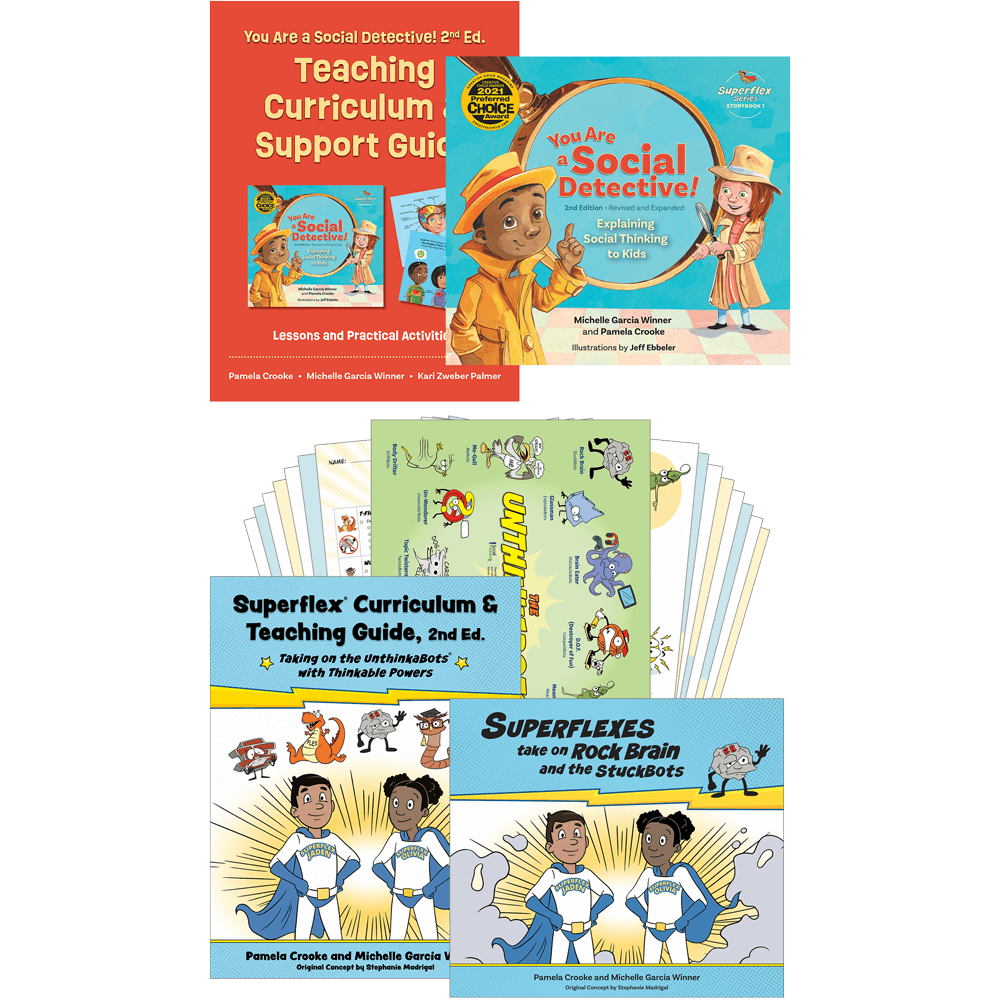
Elementary: You Are a Social Detective, 2nd Edition and its companion curriculum You Are a Social Detective 2nd edition: Teaching Curriculum and Support Guide
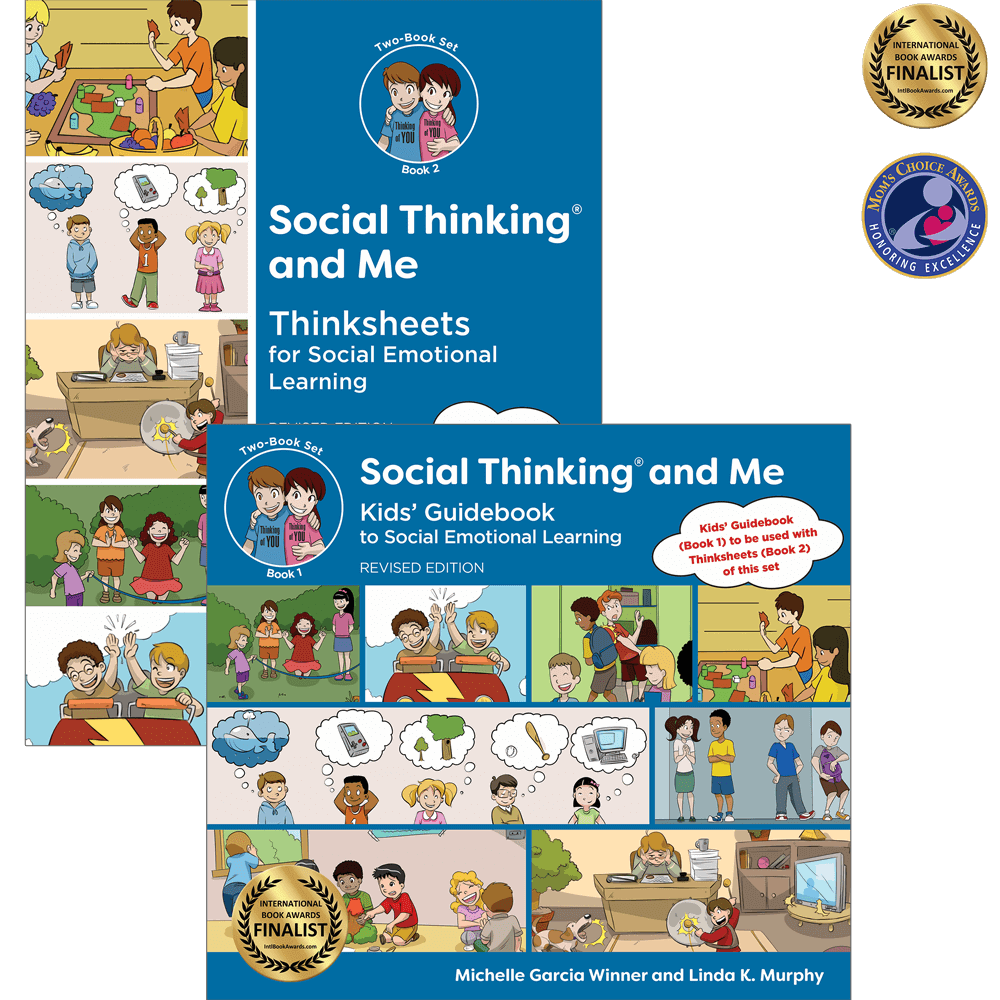
Tweens: Social Thinking and Me expands the concept by teaching kids to think like social spies, gathering clues from the world around them to better understand it.
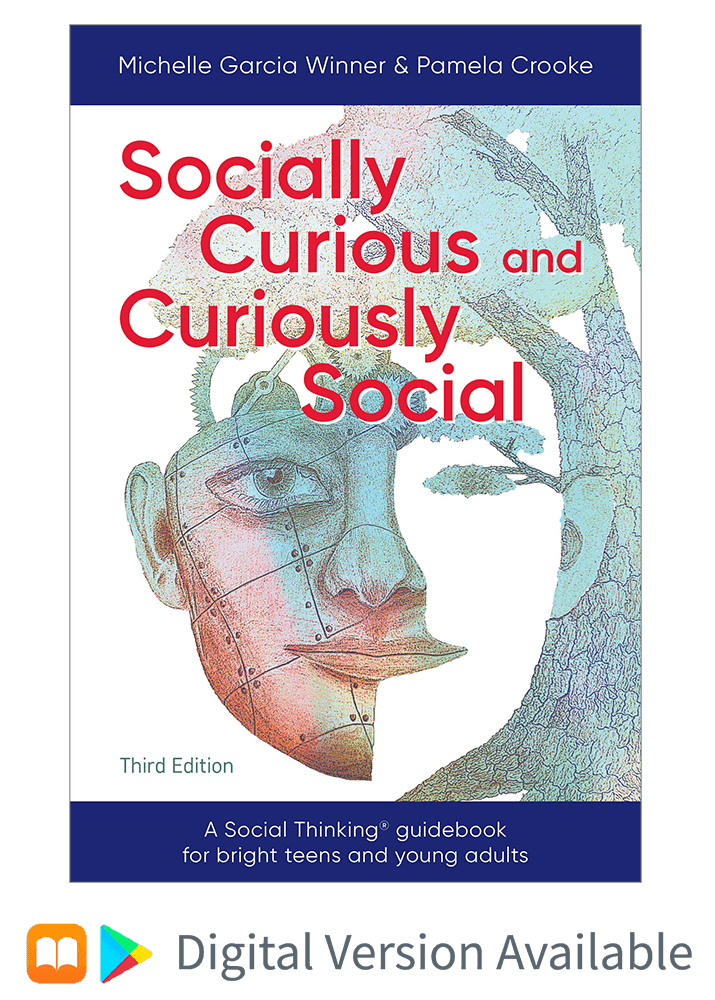
Teens and young adults: Socially Curious and Curiously Social
Next article in this series: Feeling Safer Behind Screens: Why Real-Life Interaction Feels Harder
Thanks for reading! Join our newsletter and be the first to hear about our latest products, articles, and more!
Related Resources to Support the Concepts in This Article
Products & Curriculum Sets