

Free Article


Feeling Safer Behind Screens: Why Real-Life Interaction Feels Harder
Michelle Garcia Winner, MA, CCC-SLP & Pamela Crooke, PhD, CCC-SLP
Summary:
- Online communication feels safer and more controllable than in person interaction.
- Heavy screen use may make it harder for many people to comfortably engage in the broader social world.
- Practical strategies and Social Thinking Vocabulary help individuals re-engage with the broader social world.
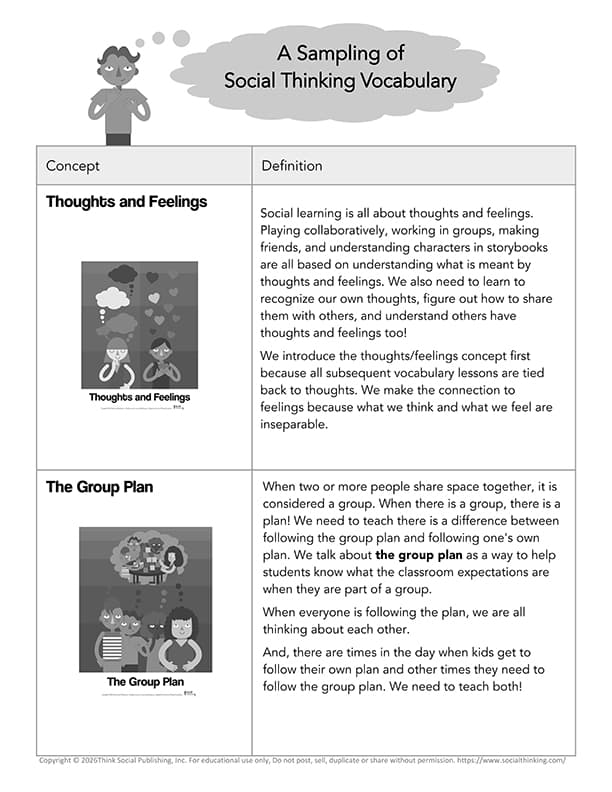
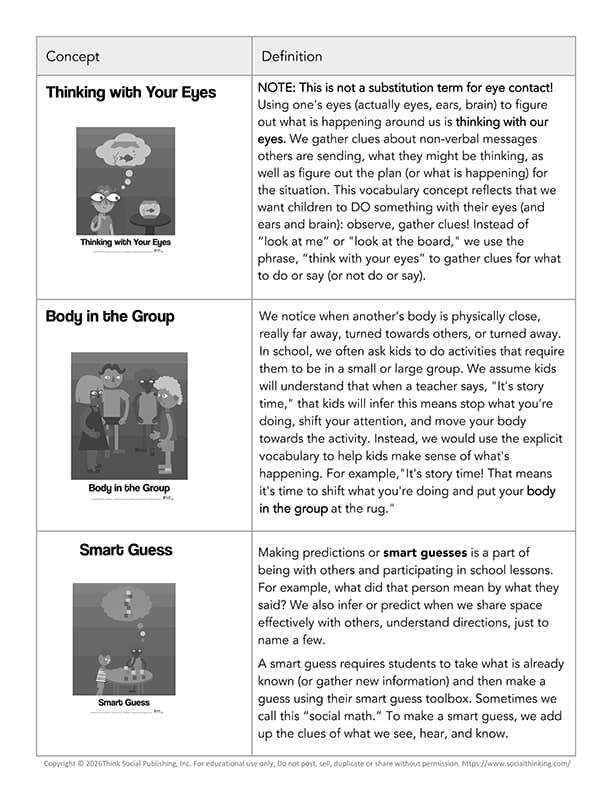
- Free Downloadable: A Sampling of Social Thinking Vocabulary
Previous article in this series: Screens Are Now the Guardrails of Childhood Social Experiences
Screens, Social Comfort, and the World Beyond the Device
Screens offer convenience, entertainment, and connection. They help us learn, work, and stay in touch. At the same time, research is telling us that heavy screen use may make it harder for many people to comfortably engage in the broader social world around them.
According to the American Academy of Child and Adolescent Psychiatry, students ages 8–18 spend an average of 7.5 hours per day on screens. Adults average 7–9 hours daily. In schools, estimates suggest students spend 1.5 to 3 or more hours per day on screens during class time alone, roughly 25%–50% of the school day. And this doesn’t include screen use during breaks, lunch, or after school.
While screen time is often discussed in relation to sleep, attention, and physical activity, one topic receives far less attention: the discomfort many people feel when stepping away from screens and into face to face social interactions.
Online communication feels safer and more controllable than in person interaction. In real world social situations, conflict can be uncomfortable and hard to avoid. It may require communication and problem solving skills, and emotions can run high. Online, however, people can disengage quickly by ignoring messages, logging off, or “ghosting” someone entirely.
Online vs. In Person Communication
Have your students reflect on whether they agree or disagree with the following ideas. Ask them to discuss which areas feel easier or safer for them and talk about what their goals are for online vs. in-person interactions.
Online, text based interactions often allow people to:
- Take time to carefully craft responses
- Communicate without facial expressions or body language
- Rely on emojis to convey feelings
- Exit uncomfortable situations abruptly
- Misinterpret tone, humor, or sarcasm
- Feel more distant from others, which can sometimes lead to harsher behavior
In person interactions, by contrast, involve:
- Facial expressions, body language, and tone of voice
- Spontaneous, dynamic exchanges
- Opportunities to clarify misunderstandings
- Greater awareness of others’ feelings
- Clear social cues when entering or exiting an interaction
The Cost of Constant Screen Use
Most digital platforms are intentionally designed to hold and command our attention. We all know (and are learning more and more) that algorithms track interests and continuously feed us new content, making it easy to lose track of time. Most of us have experienced scrolling, reading, and watching videos for way too long. As screens increasingly spill into work, school, and downtime, what else is getting pushed aside?
When asking people in different age groups what they’ve given up due to increased screen use, this is what people shared:
- Young adult: terrible sleep, less physical movement, and feeling unsure what to do without my phone in social situations because everyone is on their phones
- Adult in 30s: lower confidence meeting people face to face, no time for hobbies she once enjoyed, completing daily tasks, quality sleep, and money due to impulse buys
- Older adults: less physical activity, eye strain, difficulty staying present in the moment, sleep issues
One person summarized it simply by saying, “I’ve become too comfortable with screen based socializing instead of real life.”
Finding Balance With Intentional Practice
Screens are not inherently harmful, but as we all know—everything in moderation! Purposely making space for face to face interaction, boredom, movement, and quiet moments can help people reconnect with themselves and with others in more meaningful ways.
Re engaging with the broader social world takes intention and practice, but small, meaningful steps can make a difference. Here are a few strategies below that offer practical ways to build comfort and connection in everyday interactions.
Tip 1: Start Small With a Social Gesture
A glance, a brief smile, or friendly acknowledgment as you pass someone can be a powerful first step. These gestures are meant to be small moments to signal, I’m aware you’re there, I’m open to connecting, I’m approachable. Obviously how one goes about teaching these small gestures is based on the situation, people, region of the world, culture, familiarity with the other person, etc. One size does not fit all, so breaking this down for our students is critical. It’s more complex than a simple social skill!
Tip 2: Use Social Thinking Vocabulary to Understand the Social World
Social Thinking Vocabulary (STV) can help students understand abstract social concepts through the use of clear, concrete, explicit language. They can help students make sense of the social world and decipher some of the “hidden rules.” The vocabulary concepts can work as a way for kids to make sense of what’s happening in storybooks, classroom activities, dialogue, perspective taking, and more. The vocabulary travels across home, school, and community settings and supports both understanding and participation.
Examples of 10 core Social Thinking Vocabulary concepts, typically introduced in a specific order and grouped into two categories:
Understanding the Social World
- Thoughts and Feelings
- The Group Plan
- Thinking With Your Eyes
- Body in the Group
- Listening With Your Body and Brain
Supporting Executive Functioning
- Hidden Rules and Expected/Unexpected Behavior
- Smart Guess
- Flexible Thinking
- Size of the Problem
- Sharing an Imagination
Tip 3: The Four Steps of Face to Face Communication
In person interactions involve more than just words. Most face to face communication follows these four steps:
- Notice people in context as you approach or join an interaction.
- Establish physical presence by positioning your body near enough to show your intention to interact.
- Think with your eyes to gather information and interpret facial expressions, gestures, physical distance, what’s happening around the interaction.
- Use language to relate: we make comments, add our thoughts, and ask questions.
Tip 4: Practice the 5 Steps of Perspective Taking in Real Time
Perspective taking helps us understand others and adjust our words or actions based on what’s happening around us. These steps break down how we mentally understand each other in real time.
- I observe others, listen to their message, and notice their physical presence.
- I think about why they are here and what they might be thinking and feeling.
- I consider what they know, want, or feel based on the context and what I know about them.
- I adjust my own language and behavior to help people interpret me in the manner I had hoped.
- I interpret how they react to me and respond accordingly.
Tools for Everyone
While the Social Thinking® Methodology was originally developed to support individuals with social learning differences, these concepts are now widely used in classrooms, homes, and workplaces.
So, let’s move the conversation about screens from problem focused to solution oriented. Consider using some of these approachable strategies for teaching how to reconnect, starting with small social gestures, learning the hidden rules of the social world, and building perspective taking skills in real time. Rather than asking people to eliminate screens, let’s focus on helping individuals of all ages rebuild strategies, comfort, confidence, and connection in everyday, in person interactions.
Previous article in this series: Screens Are Now the Guardrails of Childhood Social Experiences
Thanks for reading! Join our newsletter and be the first to hear about our latest products, articles, and more!
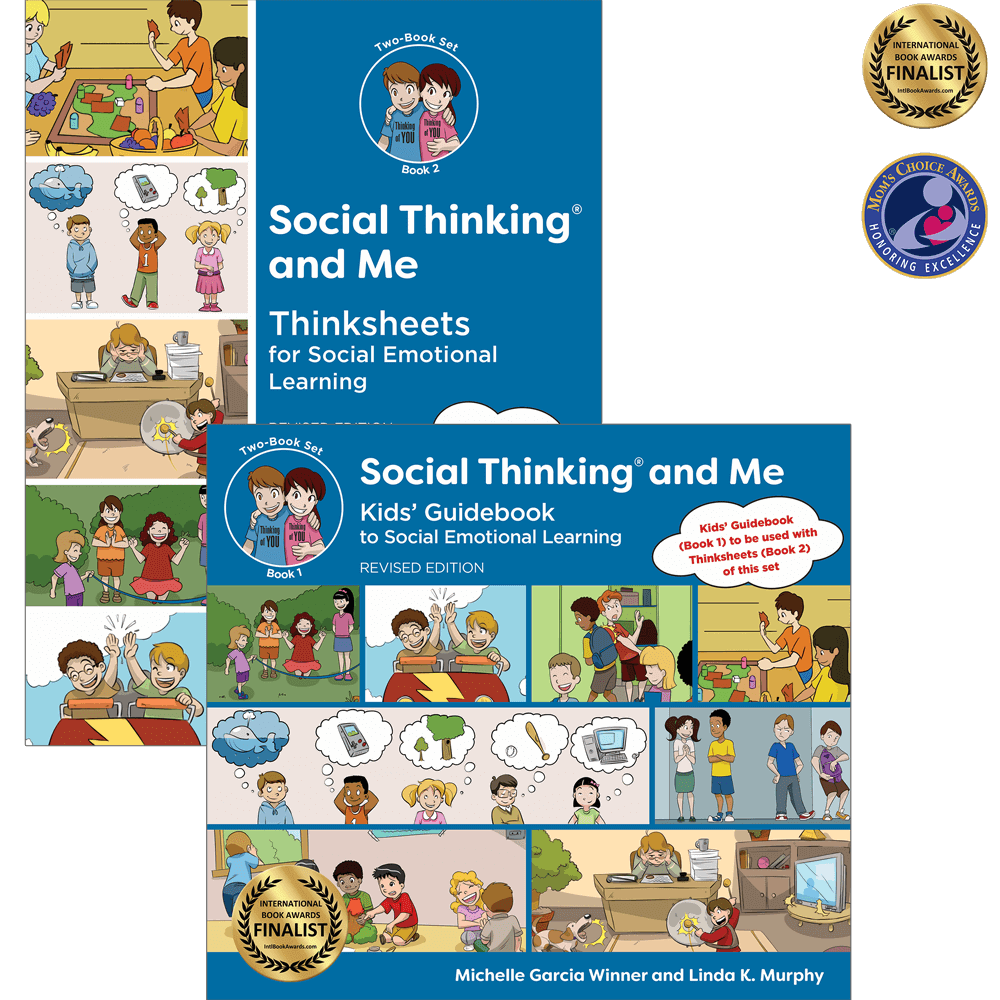
Related Resources to Support the Concepts in This Article
Products & Curriculum Sets





Free Articles