
Free Article


The Direction of Reflection
A Visual Tool for Checking In on Myself
Social Thinking Team
Summary:
- Checking in on personal feelings and thoughts is an important life skill that helps individuals understand their needs, make choices, and ask for help.
- Self-reflection does not come naturally to everyone, so using a visual framework can make the process much easier for students to grasp without feeling overwhelmed.
- A free downloadable visual tool and thinksheet are included to guide kids through a simple self-reflection circle, starting with their own emotions and moving toward their goals.
Checking in on ourselves is just part of being human. In fact, reflecting on how we’re feeling, what we’re thinking, and what we need, is often times the fuel that ignites our decisions about what we do or say (or not do or say) to meet our own goals for the situation. If we are checking in on ourselves, we can figure out if we need (or want) help from others. It can also encourage us to think about our choices, advocate for ourselves, or make a little more time to refuel.
But we may not know what we need if we don’t check in with ourselves first.
We can start by avoiding the assumption that the self-reflection process is intuitive or simple for everyone. It can be a heavy cognitive and emotional load for some. But the benefits of knowing how to check in with our ourselves is a life skill for all of us. We know that many students benefit from learning using visual tools, so here is a simple lesson for teaching about the process of checking in on oneself to figure out why we might be thinking or feeling a certain way.
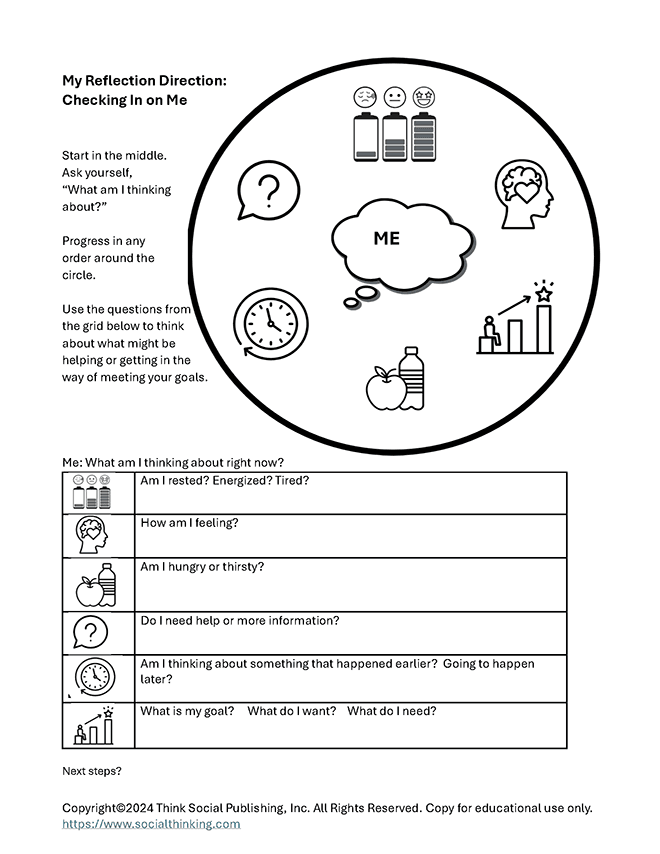
Notice in the circle below that checking in starts with ME. It’s a thought bubble but could also be a “feeling” icon (e.g., heart, emoji, etc.). The idea is to work our way around the circle, in any order that makes sense, to better understand our thoughts, feelings, goals, and actions. See the associated thinking based lesson plan (thinksheet) for introducing and practicing with this lesson.
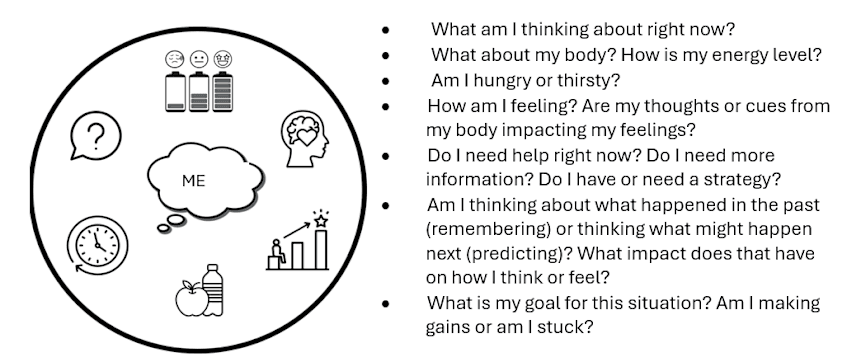
Consider that this visual and lesson is just a way to organize reflection or provide a place for discussion. It’s meant to be a jumping off place versus a “how to” process. Because this is about teaching individuals to better understand what helps and what gets in the way of making gains towards their goals, avoid trying to fix a problem or interject with your solution. However, there will be plenty of times when self-awareness and reflection can lead to the discovery of lagging social competencies like self-advocacy or self-regulation. The Social Thinking® Methodology has many tools to help individuals build those competencies to meet their goals.
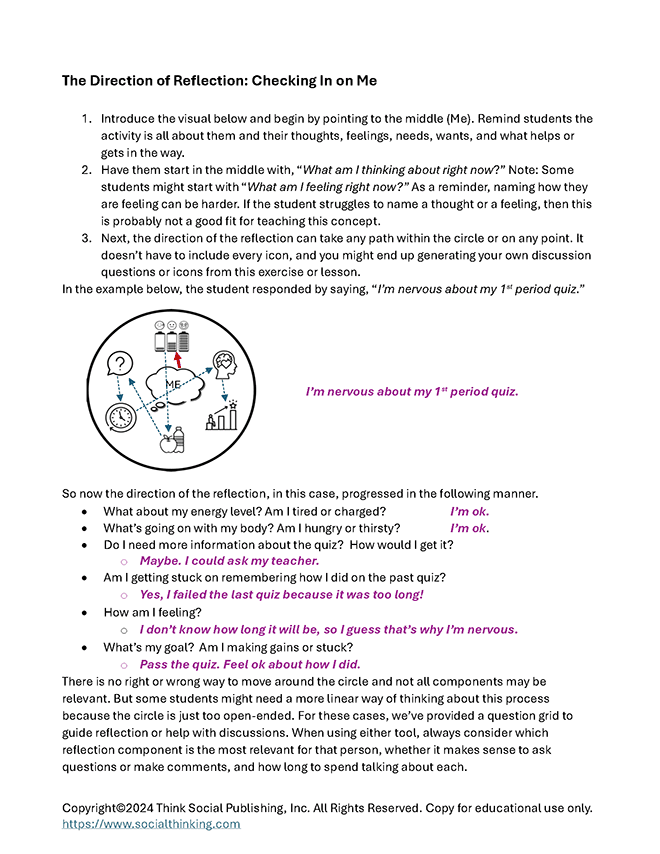
The Direction of Reflection: Checking In on Me (Download)
Thanks for reading! Join our newsletter and be the first to hear about our latest products, articles, and more!